
Reimagining where we live: cultural placemaking and the levelling up agenda
Evidence questions:
· How can culture reanimate our public spaces and shopping streets?
· How can creatives contribute to local decision-making and planning of place?
· How can the Government support places without established artistic infrastructure to take full advantage of the opportunities that the levelling up agenda provides?
· How might changes to the UK’s broadcasting landscape affect investment in cultural production outside the capital, and what could the consequences be for artists and communities?
· How should Government build on existing schemes, such as the UK City of Culture, to level up funding for arts and culture?
Create Gloucestershire (CG) is an ACE Sector Support NPO set up in 2011. Our mission is to unlock resources, spaces, confidence and skills so that art, culture and creativity can be every day, for everyone in Gloucestershire.
Our focus and expertise is cultural placemaking in communities who do not have an established artistic infrastructure. We use an approach that shares decision making with residents and have evidence that when residents and artists work together to address cultural inequality, the benefits ripple out to also tackle social, educational and health inequalities.
This is why we are submitting evidence to DCMS in this enquiry to “reimagine where we live”.
“Culture Matson is, to me, what tackling health inequalities is all about. In this space there is nothing about disadvantage and deficit and everything about collaboration, friendship, creativity and joy. It is so clear to me as a health commissioner that the benefits of a thriving creative sector to the community are cumulative: building relationships, connecting people, nurturing agency and control; and all of that leads to a community which has the health and strength to build its own destiny. It is a privilege to be part of and has fundamentally influenced the way I think about the work to overcome disparities in health access and outcome.”
Joanna Underwood. Transformation Programme Director NHS Gloucestershire Clinical Commissioning Group/One Gloucestershire
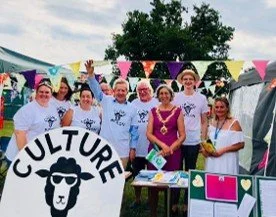
Culture Matson team celebrating at the Party in the park.
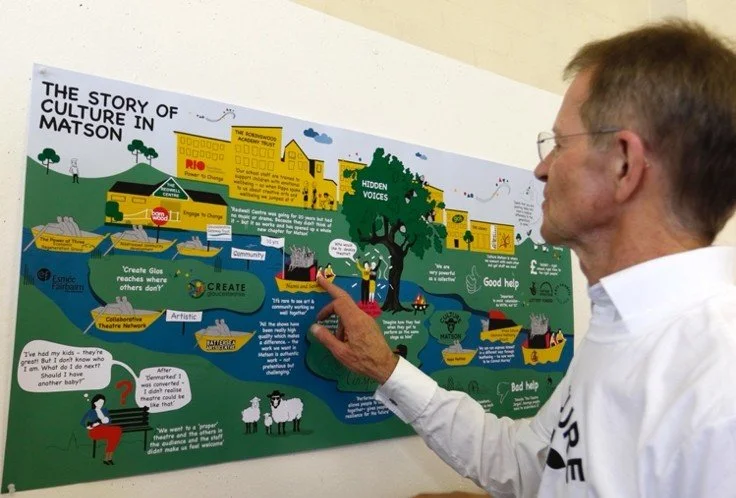
Nic Serota (ACE) studying the Culture Matson story map produced to show how the group came together.
Culture Matson, referred to in the quote above, is a creative place-based alliance that Create Gloucestershire and partners have incubated over the last 4 years. It is a resident led infrastructure. that provides new and much needed “glue” that connects residents with artists and with others with a shared agenda to improve the community such as youth workers, district councillors, teachers, health professionals, police officers, social housing staff, church leaders, local funders and commissioners.
Culture Matson has a very small and defined geographical area of interest decided upon by residents as what constitutes “their community”. Cultural activity to refresh and reanimate this area has emerged bottom up in direct response to issues that local residents bring to the table. Culture Matson is open to anyone in the community, professional and non-professional, who wants to make the community a fairer, more creative and vibrant place to live and work.
Regular and carefully facilitated meetings every 6 weeks provide residents with a safe, non-hierarchical space where they grow their confidence and skills and critically get to know other people in their community. As residents co-produce high quality artistic work alongside artists, community producers and wider stakeholders, everyone’s creativity and agency grows – this ripples out and attracts more people to engage creating a virtuous circle of activity that meets need, has significant reach and is sustained by a wide range of investors.
Evidence: During Covid Culture Matson members collaborated to “piggy back” on food distribution schemes as a cost effective and efficient way to deliver creative packs to vulnerable children and families. A Holiday Activity Programme was led by Dawn Barnes, a Culture Matson and CG Board member who runs the Venture Play Centre in White City. In the Summer of 2021, food packs were delivered over 4 weeks to 2000 children each week, 4 times a week across Gloucester City. At food community collection points, 108 sessions of art were offered with 41 artists involved. 1000 creative packs were given out by 107 volunteers who between them donated 871 hours of time.
Cam and Dursley Creatives, another resident led creative infrastructure CG has incubated in a market town in the south of Gloucestershire, achieved similar scale and reach via a partnership with GL11 (a community group in Cam) to run Pop-up Creative Cafes:
15 sessions were delivered across 5 weeks in the summer of 2020. Approx. 50 families were welcomed to each session. Over 800 creative kits were given away at the cafes and to vulnerable/shielding families supported by GL11, local foodbank and The Door Youth Project. 19 young people gained The Discover at Home Arts Award for a ceramics challenge.
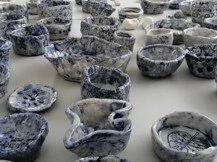
Ceramics produced by young people in Cam & Dursley for their arts award.
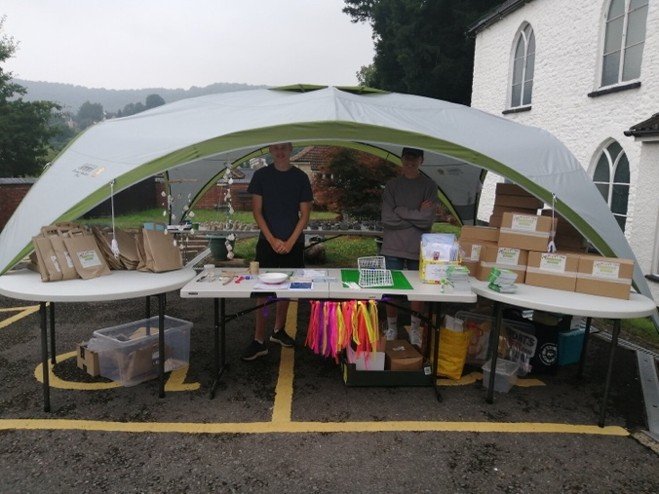
Young volunteers hand out ‘make your own table football’ packs during covid 19 pandemic.
Our experience to date, which we will be testing in 3 further places over the next few years, suggests it is possible for communities to collaborate and to effectively commission, plan and deliver creative and cultural programmes that are of the best quality and the result is more resources confidence and skills that drives further arts and culture and creativity. The activities that result are practical (they develop skills and provide pathways to employment/enterprise) and they are also beautiful which brings a renewed sense of pride and ambition to communities.
“While GL11 are able to provide food, debt advice, support to sort housing and basic needs, there is something else that creativity brings that is invaluable because it gives hope and purpose to people- it looks forward”
Indigo Redfern, Chief Executive GL11 Community Hub.
Building trust between residents and the arts and cultural sector is the single most important building block for sustainable creative placemaking. Especially so in communities that lack an established artistic infrastructure with no reference point for residents to see and know how to make where they live better, fairer and more creative.
Evidence: A “Dreaming Event” hosted by CG in April 2020 explored what people needed to unlock their dreams, ambitions and ideas as we emerged from Covid 19. 60 + participants confirmed a sense of not having “permission” or not knowing how to get involved with creative activity in their community. Some had little or no contact with arts and cultural venues in the county and a few did not even know about Arts Council England and the public funding available. The conclusions from the event were that small and safe steps were needed if those currently furthest from the arts and creative sectors were to have the confidence to get involved and that these need to be offered on the doorstep and by trusted residents and artists working together.
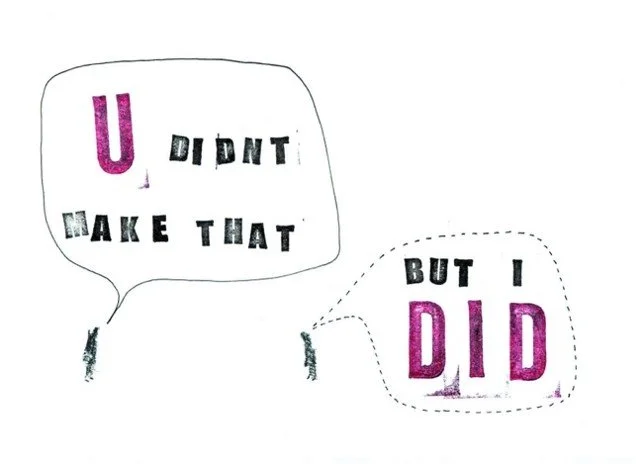
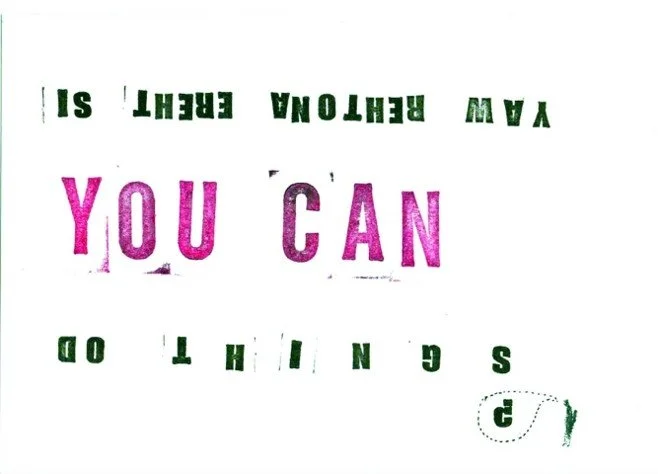
‘U didn't make that, I did.’ and ‘Is there another way?’ artwork produced by Imogen Harvey Lewis at The Dreaming event.
Artists and cultural venues have often been the “missing” professionals in many communities and if they do arrive they often “parachute in” and their goal is to “grow audiences” not the community. This is a systemic resourcing problem that we and our partners are addressing to ensure artists have the time to properly embed in communities and grow relationships with residents. (more below).
“The real work, the meaningful work for me, is with the communities who don’t have that privilege or belief that the art world is for them. I’m interested in art for all, that is inclusive to those from all walks of life and working for CG has truly helped me to recognize this and understand how I can support communities as an artist who is paid and making amazing opportunities and artworks co-designed with communities.”
Soozy Roberts, Artist and Creative Catalyst in Matson who is now setting up, GASP, a new visual arts CIC based in Matson.
The Creative Catalyst role emerged initially in Art of Libraries, a collaborative project CG delivered with Esmee Fairbairn investment to grow better joint working between libraries and the arts and cultural sectors. We realised that you couldn’t just expect people and organisations who had not worked together before (especially if this involves a mix of professionals and non-professionals) to be introduced and just left to get on with it! A broker/ trouble shooter/cheerleader/mediator was needed to create the innovation value of bringing together previously disconnected assets and sectors.
The Creative Catalyst provides this function in the Create Gloucestershire team- in the case of Culture Matson and Cam and Dursley this role is carried out by residents who know their community inside out and are trusted by other residents. Using social design principles Creative Catalysts start to gel people and sectors together and slowly but surely makers, designers, dancers, musicians, theatre makers, crafters, sculptors and writers bubble up and animate community rooms, church halls, libraries, playing fields, empty shops, school playgrounds and derelict pieces of land.
Funders, who do not traditionally fund artists, can start to see the wider social value that they can create in communities, and this creates a change in their funding or commissioning behaviour. For example, the Gloucestershire NHS Clinical Commissioning Group has commissioned Culture Matson to co-design and deliver a creative health programme strand to support residents post Covid. The Transformation Programme Director for the CCG attends Culture Matson meetings and contributes her expertise to the group as it explores creative solutions to health inequalities
A similar approach to shift decision making into the hands of the community has been developed by Strike A Light Festival, a CG member. CG was part of a team that helped to incubate Strike A Light Festival (SAL) which is now an Arts Council National Portfolio Organisation, recognised and supported for creating high quality festivals and events in Gloucester, bringing nationally significant work to the city and collaborating with Gloucester communities, local, national and international artists. SAL are key partners in Culture Matson as part of their commitment to putting Gloucester people and their stories centre stage alongside the creative brilliance that nationally significant artists and companies bring.
SAL, CG and Culture Matson have worked together to replicate this incubation process with another successful and independent arts organisation, GL4 Festival, which is run by two Matson residents and now receives Arts Council funding to programme contemporary theatre and a vibrant participation programme
“I am ringing to say that I am about to get a mortgage on a house- 3 years ago I was on benefits and could never have believed I would be in a paid job in the creative sector, running an organisation and able to do this. Thank you so much for helping me achieve this”
GL4 CIC Producer.
SAL’s Community Producers Programme, pays non theatre professionals from the community, to be the bridge between visiting artists and the communities they are working with. By paying residents to do this role, rather than asking for volunteers, there has been a shift in who can be involved in the arts. This has created a new access route for people who don’t see the arts as being for them or who have been traditionally excluded from the sector. Co creating programmes of work with community members results in higher engagement from the least engaged section of the community.
SAL has 4 diverse Community Producers working in 4 areas of Gloucester- all are supported by an SAL Producer who comes from a professional theatre background. They work alongside artists to create happenings that the community feel connected to and involved in. National artists bring creative thinking and innovation, supporting the direction and ambitions of local communities. 2 Community Producers have come via the Women Leaders South West, a programme supporting the diversification of leadership in the arts.
As well as developing new talent pathways for producers, we are also looking at how to support artists who are at the heart of the creative industries and were hit hardest by the pandemic with a particular focus on supporting artists who engage with communities as part of their work.
CG along with other cultural organisations has supported “Let Artists be Artists”, (LABA) an initiative from Strike A Light Festival which explores if having paid time and space could change the levels of trust between artists and communities. LABA is an innovative example to address inequalities in terms of who benefits from ‘The Arts’ – both as audiences and professionals. Artists go underpaid, under-heard and under-supported.
“Many artists are almost physically sick of being ‘put in the ring to fight for the scraps’ which is what it often feels like with funding application processes.”
Applicant to LABA
As noted above, effective community engagement takes time and is about relationships, conversations and artists being part of a community, not parachuting in. Artists need to be paid to do this work and critically to do the thinking with local communities about the work.
“Community engagement isn’t a workshop”
John- LABA artist.
LABA aimed to offer creatives the stability and space to be artists. For a year SAL employed (PAYE) 3 artists to create their work with no predetermined outcome in a programme that removed barriers to access, paid them for their work and put trust in artists to make.
The premise, of trusting artists to lead their own creative work and giving them financial security, dramatically increases the number of artists who can take on the role and seems to be key in addressing under-representation in the industry. 400 applicants who were diverse by artform, demographics, experience level, any metric we were able to capture, and which included significant number of applicants from backgrounds usually underrepresented in the industry.
“This changes who can be an artist”
Florence- A LABA artist
SAL worked alongside artists at every stage of designing LABA and artists led the design of the recruitment process. The feedback, loud and clear, from social media when launched, from artists involved in the process and from applicants emailing, voluntarily as well as from formal questionnaires, is that the current system of funding and commissioning artists is broken. Artists are the casualties of this, financially and in terms of mental health. People are lost from the industry, or they never enter it, because of this and inequalities are compounded. Given the negative impact of COVID-19 on workforce inequality and under-representation in the arts, the way to address this needs to be through a radical rethink of how we work with, trust, value and pay artists.
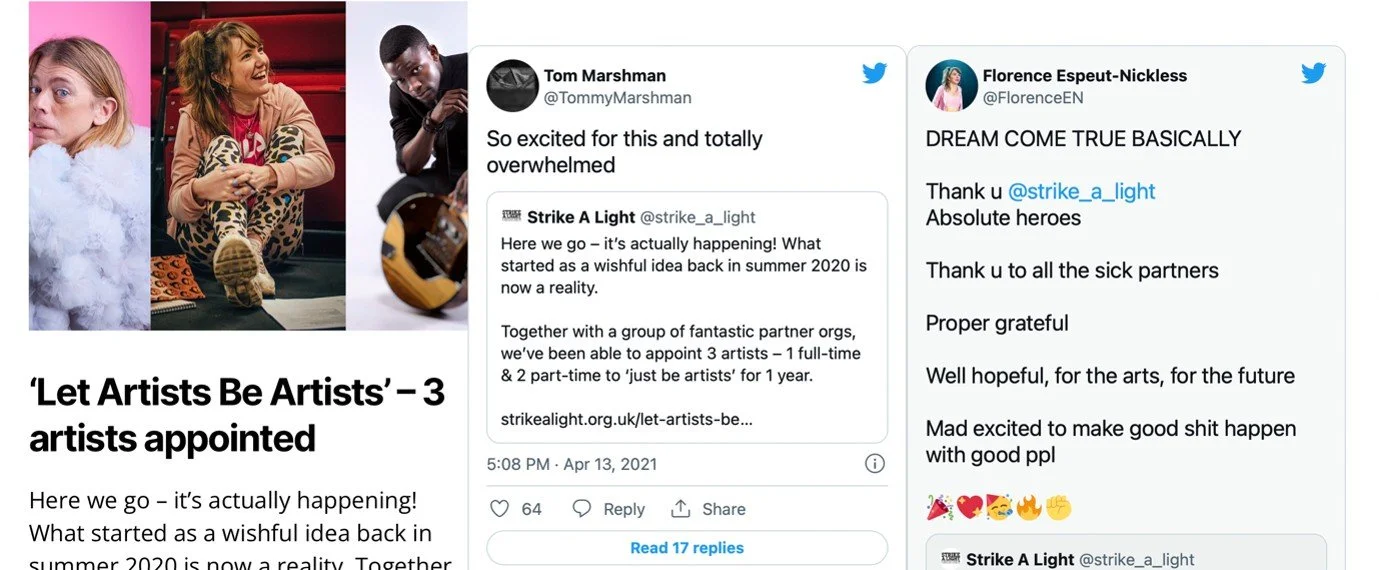
Social media reaction to LABA artist appointments.
The recruitment process for LABA is now influencing how SAL does their recruitment and a process they have shared with the wider industry. Whilst being on PAYE isn’t the ‘be all and end all’ of this project, it’s important that this work gives artists the benefits that employees of organisations get. The three LABA artists have been able to do many things for the first time ever:
take paid holiday
not worry about getting paid when they’re ill
turn down projects that aren’t right for them
undertake training
apply for a mortgage
pay into a pension
use a bike to work scheme
plan financially
see shows
“I can cover my rent and my bills”
Tom- LABA artist.
Create Funders is a strand of CG’s work that is raising the profile and funding issues of the creative sector with a range of investors who have not traditionally funded the arts. Gloucestershire Funders is a new collaborative network of funders that CG helped to set up at the start of the pandemic to speed up the funding process and reduce administration for applicants. From discussions in this group, it became apparent that confidence and knowledge in how artists can be a catalyst for creative placemaking was relatively low. CG has worked hard to address this by showcasing the work co-produced by artists and residents in Culture Matson and Cam and Dursley Creatives.
We advocate in a range of county wide policy making forums for:
· greater support for artists to be part of community policy making
· a shift away from investment in short -term activity because this reinforces a lack of trust in artists in communities-
· unrestricted funding because if the activity has been pre-determined at the application stage, a co-produced process with residents becomes impossible and so this can further undermine trust.
· Accountability for funding decisions to be devolved to resident led cultural alliances to further embed and grow creative agency and power in communities.
Another example of how CG has enabled better connectivity with the creative sector that has led to more investment in the sector is our delivery in 2021 of the Kickstart scheme, as a government appointed Kickstart Gateway organisation. Our partnership with the DWP at a county wide level, which we grew during our delivery of the Creative Employment Programme, combined with our resident led place based alliances, means we have been able to invest government funding to support to a diverse group of young people providing an all important first step in the creative industries for young people furthest from the employment market and with limited awareness of what is happening in the arts and cultural sector on their doorstep, and furthermore, support SME’s to grow and have the confidence to employ young people for the first time.
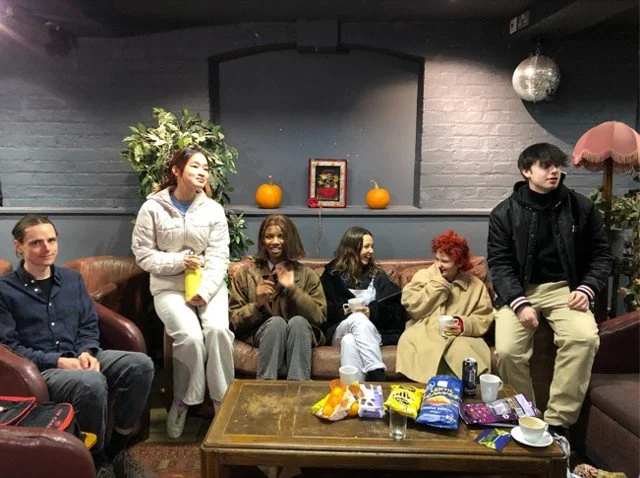
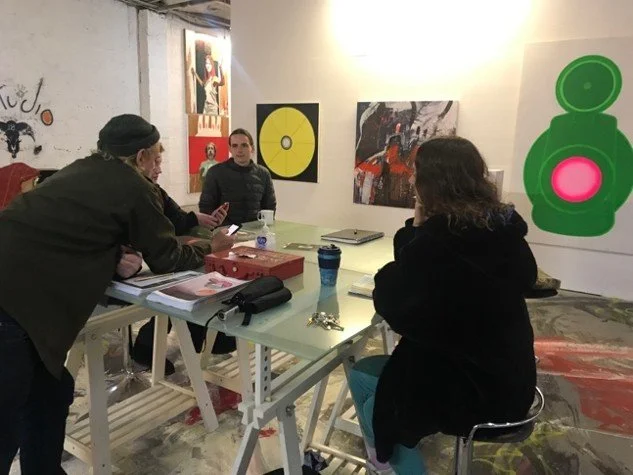
Kickstarters meet up at SVA in November 2021 to share their experience of working in one the many creative organisations in Stroud. And with Zach Walsh - Director of Studio 18, arts warehouse project.
We have been able to support 63 paid placements, with 23 creative businesses across Gloucestershire from glass blowing to sustainable fashion design and of which, 9 young people have already had their roles made permanent or extended to a year.
"We are really pleased to have been working with Create Gloucestershire as a Gateway for the Kickstart scheme. We have had limited engagement with employers in the arts and cultural sector up until now. It has given us new contacts, relationships and energy to support young people, hoping to work in this sector. It's been absolutely fantastic for Kickstart and for me, leading the Kickstart team of Employer advisors to get the chance to fill the gap with creative type roles. The Gloucestershire youth teams have been encouraged by so many new employers offering our caseloads work opportunities in the sector with some great outcomes already for long-term employment in the pipeline too. We really want to continue this partnership, and find new ways to engage through work experience, volunteering and apprenticeships. Overall, it has been met with great positivity".
Jo Smith, Gloucestershire Kick Start Employer Team Manager, DWP
With funding from Esmee Fairbairn Trust we have a 3 year plan to build and test how a resident led cultural infrastructure can provide a missing intersection point between national and county wide policy initiatives and communities most in need of them.